From Waste to Yarn – Professional manufacturer of cutting, opening & carding machines for textile recycling lines.


Cotton Waste recycling machine 150-250kg/h Metal & Spark Detection
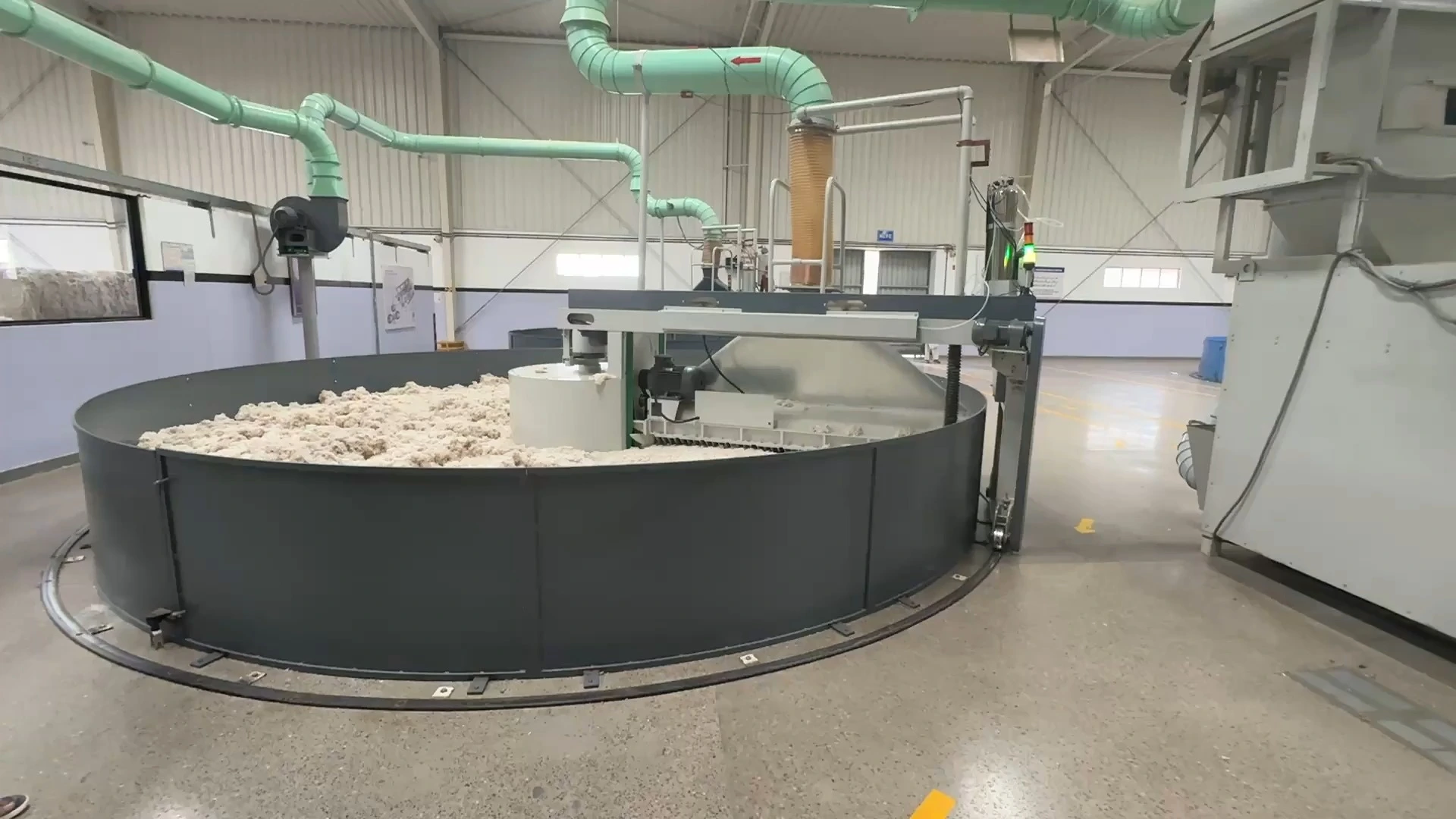
Cotton waste recycling machine processes daily by-products from spinning mills, including carding waste, combing waste, flat strip waste, floor sweepings, comber waste, and flying fibers. Through three stages—opening, combing, and impurity removal—it progressively separates dust, fine particles, metal shavings, and short fibers, producing clean recycled cotton with good fiber length and low impurity content, suitable for blending or baling and sale. The complete line includes an automatic cotton picker, metal spark detector, three-roller cleaning machine, carding machine, and automatic baler, enabling fully automatic operation from input of waste material to output of finished product. With a production capacity of 150–250 kg/hour, the system can be customized according to waste type, output requirements, and available space.
5.0
design customization
Please fill out the form below to request a quote or to request more information about us. Please be sure to upload customized requirement documents or pictures, and we will get back to you as soon as possible with a response. we're ready to start working on your new project, contact us now to get started.
Please fill out the form below to request a quote or to request more information about us. please be as detailed as possible in your message, and we will get back to you as soon as possible with a response. we're ready to start working on your new project, contact us now to get started.
Product Advantages
1. Born for spinning mills—no compromise.
This isn't a modified machine; it's purpose-built from the ground up for cotton waste, tailored to fiber type, impurities, moisture content, and contamination levels. Sweepings contain metal shavings, comber waste has short fibers, carded waste is dirty. General-purpose machines can't handle this mixed material. Ours can—because that's exactly what it was designed for.
2. Multi-stage impurity removal—from large debris to fine dust
Cotton waste impurities are layered: heavy contaminants (metal, screws, fabric scraps), medium contaminants (broken seeds, cotton husks), and fine dust (short fibers, tiny particles). Single-stage cleaning either fails to remove enough or damages fibers.
Our production line separates them step by step. Metal and spark detectors intercept hazardous materials before they enter the main cleaning zone. A three-roller cleaning machine progressively handles dust and fine particles. The carding unit completes the final stage—opening and cleaning—producing uniform, spinnable fibers.
3. Dust control—cleaner workshop, better fiber
Cleaning waste cotton generates massive dust. Our fully enclosed housing with integrated dust collection captures dust at the source.
4. Gentle fiber handling—preserving length
The challenge lies in removing impurities without breaking fibers. Too aggressive—fibers shorten, value drops. Too gentle—impurities remain, quality falls short.
Our solution: nose-shaped beaters with grid bars use density differences to separate heavy contaminants early, reducing downstream strain. The carding chamber optimizes roller speed and spacing—efficient cleaning with minimal fiber damage. Results speak for themselves: contamination drops from about 20% to below 7.8%.
5. Fit your space—even tightest quarters
Layout adapts to your workshop—not the other way around. L-shaped, multi-tiered, modular sections. Low ceiling? Narrow space? Obstacles? We work around them.
6. Dual protection—two lines of defense
Before waste enters the main cleaning zone, we set two barriers:
Metal detector—scans for ferrous and non-ferrous metals in the material stream. Screws, metal chips, damaged wire cards—all detected, alarmed, and if needed, shutdown triggered.
Spark detector—high-speed infrared sensors monitor even the tiniest flashes. A single spark triggers the fire suppression system in just 0.1 seconds—before downstream equipment is damaged.
Product specification
technical specification
Product Specifications & Trading Information
Packaging & Shipping
|
Model NO. |
MSL250 |
Delivery Time |
15-30 Days |
|
Service |
OEM/ODM |
Color |
ANY COLOR |
|
Power |
11.5kw+5.5kw |
Wire |
9210, 5610 |
|
Transport Package |
Stadard Exporting Package |
Specification |
Set |
|
Trademark |
Morinte |
Origin |
Shandong, China |
|
Size |
3550×1800×1200mm |
Fan |
4kw |
|
Manufacturing Technology |
Laser Cutting Technology |
Capacity |
150-250kg/H |
Product application direction
Spinning Mill Waste Recovery
The cotton waste recycling machine can comprehensively process cotton waste generated from various spinning processes, opening and cleaning waste materials from blowing, carding, combing, drawing, and roving stages, converting them into reusable clean fibers.
Sale of Recycled Fiber to External Buyers
Processed recycled cotton fiber can be baled and sold to downstream nonwoven mills, filling material producers, low-count spinning mills, and other manufacturers. For spinning mills with significant production scale and large waste volumes, this becomes an additional revenue stream in its own right.
Textile Waste Recycling Enterprises
Professional textile waste recycling companies collect waste cotton from various spinning mills, process it centrally, and sort it for sale. These operations handle multi-source, multi-category waste streams, placing higher demands on equipment adaptability across different feedstocks.
微信图片_20260818164441_1808_87
Cotton waste rcycling machine (2)
1
Q: What equipment does the full line include?
A: Automatic bale plucker → Metal & spark detector → Three-cylinder cleaning machine → Carding machine → Automatic baler. Waste goes in one end, finished fiber comes out the other—one pass, fully automated.
2
Q: Can you provide sample testing services?
A: Yes. Customers can send waste samples for testing. We will provide a test report and capacity evaluation for your reference in decision-making.
3
Q: What is the processing capacity?
A: 150–250 kg/h, depending on the material type and impurity content.
4
Q: What’s the total power of the full line? How much electricity does it use every hour?
A: Total power about the whole set is around 104kw, actual power consumption is about 83kw per hour under full load.
{{item.score}} Stars
{{item.pre}}%
{{item.nickname ? (item.nickname.slice(0, 2) + '*****') : item.source === 1 ? 'mall buyer' : '--'}}
{{item.comment_time}}
Review in the {{item.country}}
{{itemAttr.params_key}}: {{itemAttr.params_value}}
Get in touch with us
Just leave your email or phone number in the contact form so we can send you a free quote for our wide range of designs!
Related Products
Ready To Work With Us ?
Jinan Morinte Machinery
Links
Products
Contact Us
Contact Person: Sam You
Phone: +86 13869178806
Email: morinte@morinte.com
WhatsApp: +86 13869178806
Address: No. 122, Building 2, No. 699 Huasheng Road, Sangzidian Town, Tianqiao District, Jinan, Shandong, China