From Waste to Yarn – Professional manufacturer of cutting, opening & carding machines for textile recycling lines.


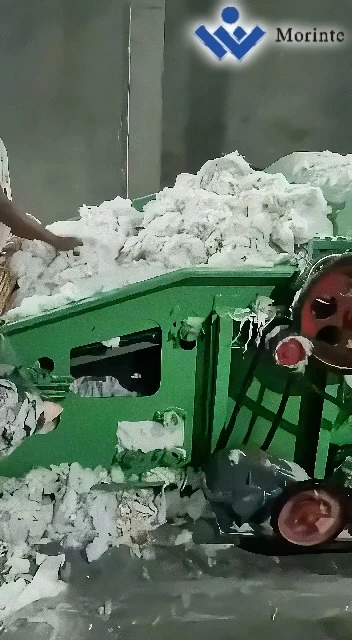
Synthetic Fiber Opening Machine 200-350kg/H MT600-400-250
The Fiber Opening Machine is an essential piece of equipment in textile waste recycling production lines. It is primarily designed to loosen compressed fiber materials, including discarded fabrics, garment offcuts, and yarn waste, into soft, fluffy fibers while removing impurities. This process provides clean and uniform regenerated fiber materials for subsequent operations such as carding and spinning.
As a key component of the textile circular economy, the machine helps transform textile waste into reusable raw materials through mechanical tearing and opening. Its main structure consists of a feeding device, an opening unit, and an impurity removal system. The core opening mechanism features a multi-roller system equipped with card clothing or metallic saw-tooth wires to effectively separate and loosen tangled fibers.
The machine is suitable for processing yarn and fabric waste made from various materials, including cotton and polyester. It is widely used in textile mills, garment manufacturing enterprises, textile recycling companies, and other related industries. By converting discarded textile materials into high-value regenerated fibers, the Fiber Opening Machine supports resource recovery and enables recycled fibers to re-enter the spinning industry chain.
5.0
design customization
Please fill out the form below to request a quote or to request more information about us. Please be sure to upload customized requirement documents or pictures, and we will get back to you as soon as possible with a response. we're ready to start working on your new project, contact us now to get started.
Please fill out the form below to request a quote or to request more information about us. please be as detailed as possible in your message, and we will get back to you as soon as possible with a response. we're ready to start working on your new project, contact us now to get started.
Product Advantages
1
Gentle Fiber Opening – Improved Fiber Quality
The machine adopts a 2+8 roller configuration, consisting of two opening rollers and eight carding rollers. Its progressive carding process gradually separates fibers rather than excessively tearing them. Jinan Morinte's proprietary "opening-before-carding" process is designed to improve fiber separation while minimizing damage. Fiber strength loss is kept below 8%, with field results showing length retention above 85% and average fiber lengths of 15 mm or more. This provides quality recycled fiber suitable for downstream spinning processes.
2
Effective Impurity Separation
The machine combines airflow separation with deceleration technology to remove impurities efficiently. Lightweight fibers are carried toward the outlet, while heavier contaminants, such as buttons, zippers, and metal pieces, fall through the bottom discharge channel. The impurity removal rate reaches 70%–80%. Adjustable dust grids and bottom-mounted suction fans further remove labels, dust, and short fibers, helping produce cleaner regenerated fiber with fewer impurities.
3
Versatile Material Processing
Designed to handle a wide variety of raw materials, the machine can process cotton, polyester, linen, fiberglass, nylon carpet, and other textile waste. It is suitable for yarn and fabric waste below 40-count. Different feeding conditions can be accommodated: tightly compressed materials can undergo pre-opening, while wet materials can be processed after drying. Adjustable feeding speed and opening intensity allow the machine to adapt to different materials and processing requirements.
Product specification
technical specification
Product Specifications
Packaging & Shipping
|
Model No. |
MK600x1000mm |
MK400x1300mm |
MK400x1300mm |
MK250x1300mm |
|
Capacity |
300-350kg/h |
400-450kg/h |
350-400kg/h |
300-350kg/h |
|
Roller size |
600x1000mm |
600x1300mm |
400x1300mm |
250x1300mm |
|
Dust case |
4kw fan to transport materail |
500x1300mm |
500x1300mm |
500x1300mm |
|
Power |
37kw/roller |
30kw/roller |
15kw |
11kw/2roller |
|
Weight |
1200kg |
1500kg |
1100kg |
650kg |
Product application direction
Nonwoven Manufacturing — From Textile Scraps to Functional Materials
Recycled fibers can be used as raw materials for nonwoven products, including insulation felts, padding, filtration-related materials, and industrial nonwoven fabrics. With appropriate fiber preparation and downstream processing, textile waste can be converted into useful materials for a wide range of industrial applications, creating additional value from discarded textiles.
Building Materials — Recycled Fibers for Panels and Insulation
Opened textile fibers can be incorporated into selected building material formulations to manufacture insulation boards, composite panels, and other fiber-based products. Depending on the material composition and manufacturing process, recycled fibers may be combined with resin, cement, or other suitable binders. This application provides an alternative outlet for hard textile waste that is difficult to reuse in conventional spinning processes.
Automotive Interiors — Sound and Thermal Insulation
Recycled textile fibers can serve as raw materials for automotive nonwoven components, such as sound-absorbing felts, thermal insulation layers, and interior padding. When processed with suitable bonding materials and manufacturing technology, these fibers can help produce lightweight, functional components while supporting the automotive industry's efforts to increase recycled material content. Final performance depends on fiber composition, binder selection, and product specifications.
Mattress and Furniture Filling — Recover Fibers for Cushioning
Textile waste can be opened and processed into recycled fibers for selected mattress padding, sofa cushions, furniture filling, and other cushioning applications. After appropriate cleaning and quality control, recovered fibers can be blended with other filling materials according to the required softness, resilience, and density. This creates an additional reuse channel for garment offcuts, upholstery waste, and other suitable textile scraps.
微信图片_20260817140610_1793_87
微信图片_20260817141316_1794_87
微信图片_20260817141318_1795_87
1
How much workshop space is required to install the complete recycling line?
The main recycling line occupies approximately 13.5 × 4.5 meters. We recommend reserving a workshop area of at least 15 × 6 meters to allow sufficient space for material feeding, operation, maintenance, and routine cleaning.
2
What types of textile waste can this recycling line process?
The line is designed to process a wide range of textile waste, including cotton, polyester, linen, ramie, jute, hemp, banana fiber, pineapple fiber, wool waste, old garments, fabric scraps, waste yarn, and nonwoven materials. Processing suitability depends on the material composition, moisture content, and feeding condition.
3
Can the machine speed be adjusted to suit different materials?
Yes. Frequency inverters can be installed to adjust motor speeds according to different raw materials and processing requirements. A PLC control system is also available as an optional configuration to support more convenient operation and coordinated control of the production line.
4
What is the total power requirement and actual electricity consumption?
The installed power of the complete line is approximately 104 kW. Actual power consumption is estimated at around 83 kWh per hour under full-load operating conditions. Actual consumption may vary depending on the raw materials, operating conditions, and production settings.
5
What documents and technical support are provided with the machine?
We can provide the applicable inspection documents, commercial invoice, packing list, and other required shipping and customs clearance documents. A Certificate of Origin can also be arranged when applicable. Installation guidance, operating instructions, and technical support can be discussed according to the project requirements.
{{item.score}} Stars
{{item.pre}}%
{{item.nickname ? (item.nickname.slice(0, 2) + '*****') : item.source === 1 ? 'mall buyer' : '--'}}
{{item.comment_time}}
Review in the {{item.country}}
{{itemAttr.params_key}}: {{itemAttr.params_value}}
Get in touch with us
Just leave your email or phone number in the contact form so we can send you a free quote for our wide range of designs!
Related Products
Ready To Work With Us ?
Jinan Morinte Machinery
Links
Products
Contact Us
Contact Person: Sam You
Phone: +86 13869178806
Email: morinte@morinte.com
WhatsApp: +86 13869178806
Address: No. 122, Building 2, No. 699 Huasheng Road, Sangzidian Town, Tianqiao District, Jinan, Shandong, China