From Waste to Yarn – Professional manufacturer of cutting, opening & carding machines for textile recycling lines.


Morinte Waste Fabric Processing Machine 300kg/h GRS Recycling Line
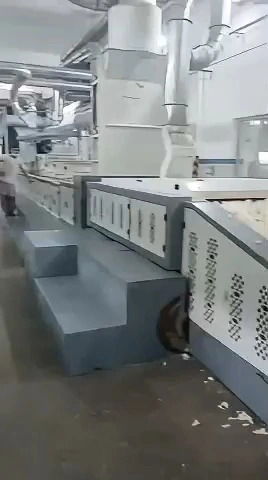
Morinte Waste Fabric Processing Machine is a fully integrated textile waste recycling system specifically designed to convert discarded textiles into high-quality, recyclable fibers. This equipment can handle various hard and soft textile wastes, including cutting waste from garment factories, waste yarns, old clothes, knitted decorative trimmings, denim fabric slices, non-woven fabric residues, and industrial post-processing garments. The production line uses pure mechanical force to crush textile waste into fibrous form, without the need for strong corrosive chemicals, achieving this through efficient mechanical cracking. The complete integrated process flow is: cutting → metal and spark detection → humidity adjustment → fiber cracking → packaging. Each step has been meticulously designed to protect fiber quality, ensure operational safety, and maintain a clean and stable production environment.
5.0
design customization
Please fill out the form below to request a quote or to request more information about us. Please be sure to upload customized requirement documents or pictures, and we will get back to you as soon as possible with a response. we're ready to start working on your new project, contact us now to get started.
Please fill out the form below to request a quote or to request more information about us. please be as detailed as possible in your message, and we will get back to you as soon as possible with a response. we're ready to start working on your new project, contact us now to get started.
Product Advantages
1
Fiber retention, recyclable for spinning
By using progressive loosening and adaptive needle roller control, the length of fibers is maximally retained during the powerful disassembly of used textiles. The recycled fibers can be directly reused in the spinning process, allowing waste materials to truly return to the value chain.
2
Multi-level impurity removal, not afraid of contamination
To address the problem of large variations in impurities in waste textile materials, multiple-level impurity removal methods such as magnetic separation for metals, air flow screening for light and heavy impurities, and centrifugal separation for buttons and zippers are integrated. The impurity removal rate is industry-leading.
3
Variable frequency drive, energy saving and cost reduction
Each drive unit is independently variable frequency speed-controlled, and the rotational speed can be flexibly adjusted according to the material condition to avoid "big horses pulling small carts". Small-scale recycling processing plants can be set up, and the operational cost advantage is obvious.
4
Flexible production capacity, customizable
The production capacity covers multiple levels from 200 to 300 kg/h, and can be adapted for both small-scale recycling processing and regional centralized treatment. Under the same system, the system can be flexibly configured based on the investment scale and raw material quantity, without waste or compromise.
5
Complete set delivery, easy implementation
The integrated design of cutting, loosening, separation, packaging, and dust removal throughout the process ensures that waste materials are completed from entry to exit within a single system, eliminating the need for manual transfer between multiple equipment. Turnkey complete production lines reduce the difficulty of on-site integration and provide higher certainty of implementation.
Product specification
technical specification
Product Specifications
Packaging & Shipping
|
Model No. |
MKS600x1300mm |
MKS400x1300mm |
MSL250x1300mm |
|
Capacity |
300-350kg/h |
250-300kg/h |
200-250kg/h |
|
Roller size |
600x1300mm |
400x1300mm |
250x1300mm |
|
Dust case |
500x1300mm |
500x1300mm |
500x1300mm |
|
Power |
30kw/roller |
15kw |
11kw/two rollers |
|
Weight |
2500kg |
1400kg |
700kg |
Product application direction
Waste fabric is processed through loosening, sorting, combing and packaging, transforming into different qualities of recycled fibers. The long and strong ones are used for re-weaving; the medium-length ones are used in automobiles and construction; the short and mixed ones are used for household items and agriculture. The quality determines the destination, and the gradient determines the value - a single production line, connecting the complete application chain from textile to automobiles, construction, household items and agriculture.
01. Textile and Apparel Industry
High-quality recycled fibers are reintroduced to the spinning process to be transformed into new fabrics and garments. The retention rate of fiber length is ≥ 85%. Recycled fibers can be directly reused for ring spinning or air jet spinning, achieving a closed-loop recycling process from "used clothes → fibers → new clothes"..
2. Automotive and Transportation Industry
Medium-quality recycled fibers are widely used in automotive interiors and sound insulation and heat insulation components. EU regulations require that the proportion of recycled materials in new vehicle plastics be no less than 20%. The demand for recycled fibers in the automotive industry continues to grow.
3. Construction and Infrastructure Industry
Medium and low-quality recycled fibers are applied in the fields of building insulation, soundproofing and civil engineering. The sound absorption coefficient of the building soundproofing boards made from recycled fibers can reach over 70%, and the thermal conductivity is within the range of 0.034 - 0.05 W/m·K. Recycled cotton felt is a necessary material for the maintenance of bridge concrete. This is one of the directions with the largest consumption of recycled fibers.
4. Home and Agriculture Industries
The short and coarse recycled fibers flow to essential applications such as furniture filling and agricultural insulation. Recycled cotton felt is inexpensive and has good breathability, and is used for sofa filling, mattress padding, and packaging of mechanical equipment. For applications such as the inner core of agricultural greenhouse insulation blankets and bedding materials for animal farms, the requirements for fiber length and color are low, and the cost is controllable, allowing even the poorest waste to have an outlet.
微信图片_20260817140610_1793_87
微信图片_20260817141316_1794_87
微信图片_20260817141318_1795_87
1
Q: Does the machine support OEM/ODM and custom voltage?
A: Yes. OEM/ODM is available. The machine color can be customized, and voltage can be customized according to customer requirements. Electrical components can also be selected based on the customer’s requirements.
2
Q: What after-sales service is provided?
A: The machine comes with a 12-month warranty. After-sales service includes onsite support and video support. Engineers are available to service overseas.
3
Q: What is the response time of the spark detector?
A:The response time of the spark detection system is ≤ 100ms. From the time the detector captures the spark signal, to the time the host issues an alarm and activates the actuator (stopping the fan, starting the fire removal, etc.), the entire system response is completed within 100 milliseconds.
4
Q: What kinds of waste can this production line handle? Can it process cotton, polyester, old clothes, linen and synthetic waste materials?
A: It can handle almost all textile waste, including old cotton and polyester clothes, fabrics, waste yarn; natural fibers (flax, ramie, jute, hemp, pineapple fiber, banana fiber); non-woven fabrics and wool waste.
5
Q: Is it necessary to frequently replace the wearables when switching different raw materials?
A: No. The equipment can handle various materials including denim, linen, non-woven fabric, woven bags, and leftover fabric from clothing, etc. When changing the type of raw materials, there is no need to frequently replace the wearables, which effectively reduces the operating costs of enterprises that recycle multiple varieties of materials.
{{item.score}} Stars
{{item.pre}}%
{{item.nickname ? (item.nickname.slice(0, 2) + '*****') : item.source === 1 ? 'mall buyer' : '--'}}
{{item.comment_time}}
Review in the {{item.country}}
{{itemAttr.params_key}}: {{itemAttr.params_value}}
Get in touch with us
Just leave your email or phone number in the contact form so we can send you a free quote for our wide range of designs!
Related Products
Ready To Work With Us ?
Jinan Morinte Machinery
Links
Products
Contact Us
Contact Person: Sam You
Phone: +86 13869178806
Email: morinte@morinte.com
WhatsApp: +86 13869178806
Address: No. 122, Building 2, No. 699 Huasheng Road, Sangzidian Town, Tianqiao District, Jinan, Shandong, China